Monday, October 21, 2013

An Incorrect Guess About The Voltage Regulator

In a previous post of mine about the Zalman fan controller, I guessed that the voltage regulator was an LM317T. I came across a blog post about the same controller and the author said that the voltage regulator was a 7805. So I decided I had to verify that I was wrong. And I was. I desoldered the regulator from the board so I could identify it.
DSCF1650
Fairchild KA7805. I’m not sure what E33 means. “Although designed
primarily as fixed-voltage regulators, these devices can be used with external components for adjustable voltages and currents.”
DSCF1641DSCF1644
The resistor measures 708 ohms. I was wrong about it and the potentiometer as well. In-circuit measurment is not always ideal. Likewise reading resistor color codes in bad light through a small aperture is difficult.
DSCF1645
Violet, brown, black, black, brown, a 710 ohm, 1% resistor.
DSCF1648
The potentiometer measures between just over 0 ohms and 1K ohms.
Hey, I have some 7805 regulators in my parts library as well, so I can still make some fan controls if I want. Not that I will. And yes, I soldered it back together.

Sunday, October 13, 2013

Keithley 160B Digital Multimeters and Failure.

DSCF1391
I bought 3 Keithley 160B Digital Multimeters at one of the OSU sales last month. They were $5.00 each. Why did I buy all three? Because who knows if they would all work. And because, that’s why. Also they all worked except that none would display amperage…and one other thing.

DSCF1393
When I said they might not work, notices like this on the top of all three are why. They came out of LBCC and were likely abused by students.

DSCF1394
The back has Analog Output. Except it doesn’t.

DSCF1397
The underside. The cord wraps around the outside of the legs.

DSCF1396
Instructions.

DSCF1398
I opened it up upside down. Don’t do that.

DSCF1399
The screws are held with o-rings underneath the 4 brown pillars/risers. I didn’t take any pictures because it’s obvious. The red arrow points to the location of the 3rd, non obvious, fuse. The two obvious fuses are fine.

DSCF1402
The non-obvious fuse.

DSCF1405
The fuse socket.

DSCF1407
The analog output isn’t hooked up to anything.

DSCF1410
This is the one with the most notes on top. The “LSD BAD” is my own note. As the Least Significant Digit in the display does not work (that one other thing) on this unit.

DSCF1412
The battery pack was present, only without batteries. It will not be used as it requires a slew of NiCad cells.

DSCF1413
Maybe I’ll put it up on Ebay.

DSCF1416
Testing a non-obvious fuse. Open is bad.I bought this multimeter at an OSU sale as well.

DSCF1419DSCF1422DSCF1424
Worlds of circuits…

DSCF1430
On the left, the replacement fuse. I don’t know why it’s a LFMX rather than a LF. The Keithley manual (you can download one from their site and there are other copies eiaser to access as well on the web) states that it’s a Fuse, 3A, Microfuse, part 273003 made by Littelfuse. I bought 3 from Newark. With shipping, they cost more than the multimeters did.

DSCF1431
With fuses installed in all units, I tested the amperage readings. They all work now…except for the one that doesn’t.

DSCF1436
While the 160B has a 3-1/2 digit readout, meaning that it displays 1XXX or XXX as appropriate, the bad Keithley doesn’t display the last digit. Curiously it displays the dot.

DSCF1440
This is what I get for probing carelessly, I blew up all the digits.

DSCF1447
Those are some wrinkled traces (or wrinkled solder mask). The wrinkling is worse on this unit than the others.

DSCF1453
I removed the board…DSCF1454
I had a bunch of identical LED displays, so I desoldered the bad ones and put new ones in.

DSCF1458
Testing…this time with better current limiting.

DSCF1507DSCF1509
I still wasn’t able to get the last digit to light up. So I plugged the display from the bad unit into the board of a good unit. It lit up, sort of. I possibly damaged the new LED digit when soldering, or probing, or it was already bad. But it lit up more than when hooked up to the bad unit’s board. which means that it isn’t the display that’s bad. I didn’t want to hook a good display up to the bad one’s board as there was a possibility it was burning out the digits, and I didn’t want to make things worse.

DSCF1513
I think it’s either the transistor that switches the LED (it’s a multiplexed display) or the input to that transistor. Or a faulty trace. Or black magic. Anyway I’m probably not going to invest more time tracking down the problem. The unit isn’t worth it. I’ll either sell it, trade it, scrap it (it has some nice .1% resistors) or just let it sit in my junk pile. Not sure, I have two others that work fine.

Friday, September 20, 2013

I Win The PanaVise Contest

I discovered that PanaVise is running a contest every month on their Facebook page, where they ask people send in pictures of their PanaVise use, modifications, etc. Being the sort of guy who uses PanaVises I sent in a picture of my third-hand jig that mounts in a PanaVise base. As nobody else entered in August, I won by default. I’m sure I would have won even if I had competition. No, I wouldn’t, I’ve won two things in my life, a pumpkin in 7th grade and two ugly centerpieces at a Eugene Chamber of Commerce dinner. Both prizes were underwhelming. But the third time is the charm and a box arrived from PanaVise today!
DSC03910
A box, the suspense is killing me.
DSC03911
Nick! Why are you teasing us? Move aside, foam peanuts.
DSC03913
Cool!
DSC03914
And there’s more…so what did I get?
DSC03916
A PV JR. which is really handy for electronics projects.
DSC03915
A nice weighted base that works with the vise or any of my other PanaVises.
DSC03917
A speeder handle and some non-marring neoprene jaws. Nice.
DSC03919
I stuck the rubber feet on the base…
DSC03925
This will be useful.

DSC03927
Rubber jaws will be good for when I take up quail egg engraving or toothpick carving.
DSC03928
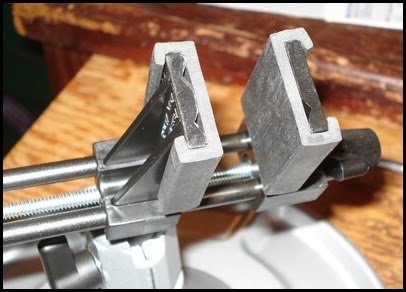
Vee grooves in the jaws so I can hold round things.
DSC03929
Like this screwdriver. Not that I need to hold screwdrivers, it was the only round thing I had to hand besides a pen.
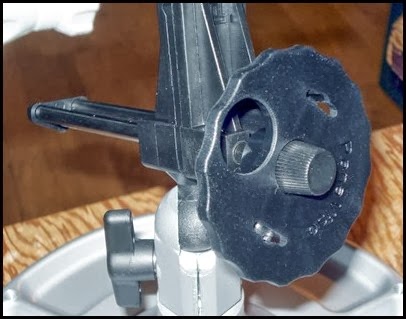
DSC03932
The Speed Control Handle. It works well.
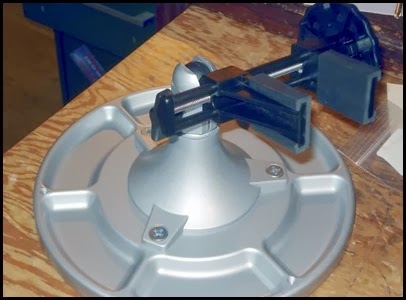
DSC03933
Adjustability! Thanks so much, nice people at PanaVise!
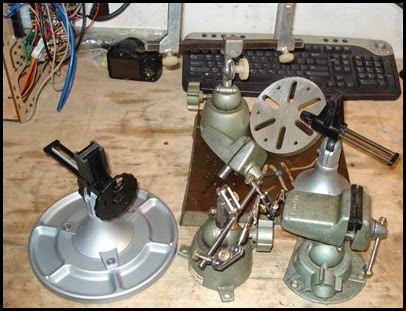
DSC03935
Oh, might as well introduce it to the rest of my PanaVise herd.
DSC03937
I already had a worn PV JR. While it seems redundant, trust me, there are many situations where having two identical vises comes in really handy.
DSC03938
Since nobody has entered the contest this month, and they explicitly told me I could enter again, here’s my engraving vise mount. I used this until I bought a proper engraving vise. I hope I win again. I obviously need more vises.
DSC03939DSC03942DSC03943
Made from a cheap import jeweler's hand vise, bolt & nut and a piece of steel rod I drilled out for the bolt. Simple. I see Eurotool makes one that is way flimsier. PanaVise should die cast a head like this. They would probably sell dozens and curse my name for suggesting it.
Anyway, back to PanaVise.
DSC03944
My 309 base says “COLBERT DIE CAST CO.INC”
DSC03946
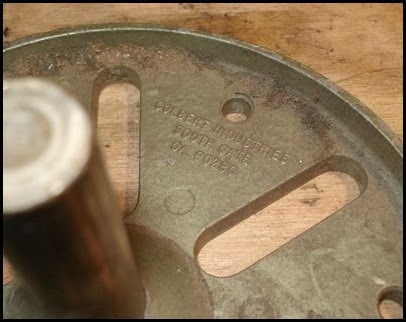
My 337 head “COLBERT INDUSTRIES”
DSC03948
“Pana Vise” or “PanaVise”?
DSC03949
Notice the old style of low profile vise.
DSC03951
Manufacturing was simplified. While I love the rounded guide rods and screw, there is absolutely no reason to add cost by making the parts that way.
DSC03952
There different bases and logos.
DSC03953DSC03955DSC03956
If only my only vice were vises.